









Always in sync, even across episodes
No more "wait, let me pause" moments. Our sync engine keeps everyone frame-perfect—even when you binge multiple episodes in one party.
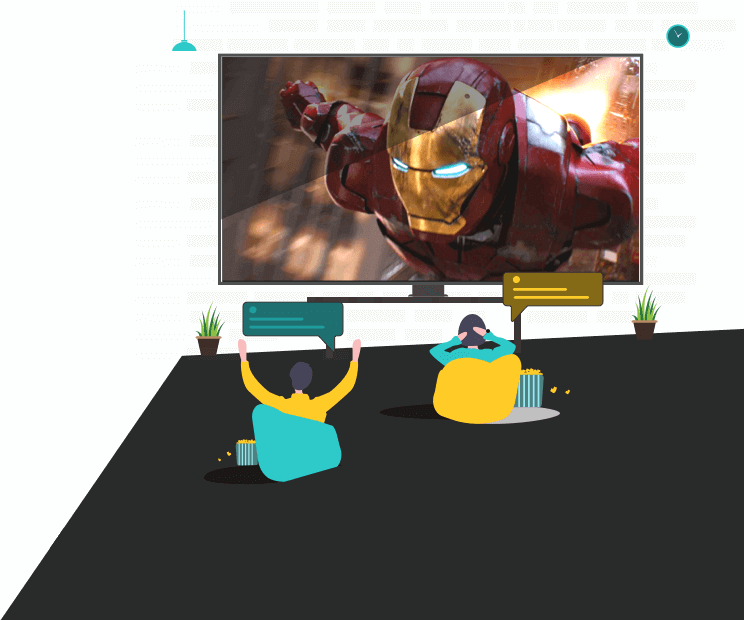
Start playing any video on Netflix, Disney+, or 10+ supported platforms.
Click the Flickcall logo on top right once video starts or hit the Flickcall icon on chrome toolbar. Your watch party is ready in one click.
Copy the party link and send it to your friends. They join with one click—no sign-up required.
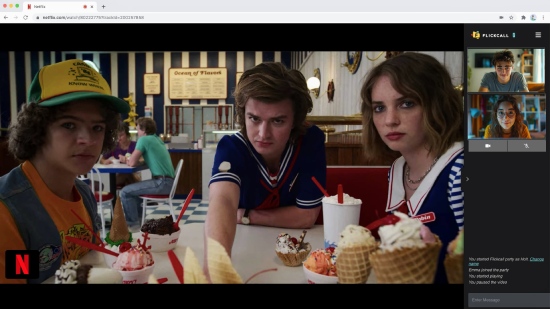
Create watch parties on Netflix, Disney+, JioHotstar, JioHotstar, HBO Max, MAX, Hulu, Prime Video, Youtube, Zee5, Sony Liv, JioHotstar with Flickcall.

No more "wait, let me pause" moments. Our sync engine keeps everyone frame-perfect—even when you binge multiple episodes in one party.

Catch your friends gasping at plot twists. Share laughter in real-time. Video chat makes every watch party feel like you're on the same couch.

Install the extension, play any video, click the Flickcall icon. That's it—share the link and you're watching together.
When you pause video, your mic unmutes. When you play, it mutes. Smart Mic knows when you need to talk. No fumbling with buttons, just natural conversation.

We use peer-to-peer technology to connect you directly with your friends. Your video calls and chats are never routed through our servers unless direct connection is blocked*.
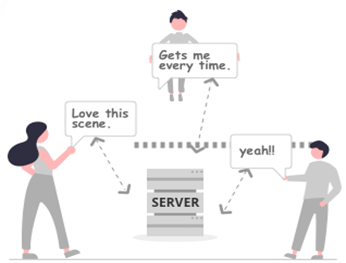

* In some cases, firewall setting doesn't allow direct connection, the calls and messages are encrypted and transmitted via routing servers.
The first and most profound stories are told through the joint family system. In the West, the individual is often the hero of the story; in India, the family is the protagonist. A typical urban Indian morning might begin with a grandmother chanting slokas in the puja room while her grandson scrolls through his phone, waiting for his mother to pack a tiffin box layered with spices and love. The story here is one of negotiation between the ancient and the modern. The conflicts—over career choices, marriage partners, or screen time—are the plot twists. Yet, the resolution is almost always collective. The ethos of "Vasudhaiva Kutumbakam" (the world is one family) starts at home, teaching a lifestyle where privacy is less important than presence, and where elders are not retired citizens but living libraries of memory and morality.
India does not exist in history books alone; it breathes, eats, and celebrates in the labyrinthine lanes of its cities and the quiet, sun-baked fields of its villages. To speak of the Indian lifestyle and culture is not to describe a single, monolithic entity, but to listen to a million stories told simultaneously. These are not just tales from mythology or folklore; they are the living, breathing narratives embedded in the everyday rituals of a subcontinent. From the scent of wet earth after the first monsoon rain to the cacophony of a morning market, Indian culture is a story that never ends—it is an epic written not in ink, but in habit, tradition, and resilience.
In conclusion, the stories of Indian lifestyle and culture are not found in a single book or museum. They are found in the namaste greeting that acknowledges the divine in another person, in the rangoli powder that dissolves at the first footstep, and in the chai wallah who knows your order before you speak. To live in India—or to truly observe it—is to accept that you are a character in a story much larger than yourself. It is a narrative of staggering diversity, immense spiritual depth, and a stubborn, joyful insistence on life. It is, without a doubt, the world's longest-running, most colorful soap opera—and every day, a new episode begins.
Yet, the most powerful stories are the silent ones—the resilience of a farmer in Vidarbha, the grace of a Kuchipudi dancer preserving a 2,000-year-old gesture, or the coder in Bengaluru who designs an app while wearing a starched cotton kurta . The Indian lifestyle is marked by a profound ability to hold contradictions: ancient temples stand in the shadows of skyscrapers; cows block traffic as Teslas honk behind them; a high-powered executive might end a Zoom call to light a lamp for the evening aarti . These are not inconsistencies; they are the dual narrative lines of a country that refuses to erase its past to embrace its future.
Food, of course, is the most delicious narrative of all. Indian cuisine is not a list of dishes but a geographical and historical archive. The use of coconut in the South tells of a tropical, coastal existence; the heavy cream and nuts of the North speak of Mughal influences and royal kitchens. A single story of a family recipe for biryani might include layers of a 1947 partition migration, a grandmother’s secret spice blend, and the modern daughter’s attempt to make it "air-fryer friendly." Festivals like Diwali or Eid are not just religious events; they are the climax chapters of the year’s story. The entire nation becomes a character, donning new clothes, lighting lamps, and exchanging mithai (sweets) as metaphors for the victory of light over dark, knowledge over ignorance.
Beyond the threshold of the home, the story shifts to the spectacle of the everyday marketplace. Consider the sabzi wali (vegetable vendor) arranging her wares in a perfect gradient of red tomatoes, green chilies, and orange carrots. She is a storyteller, arguing over two rupees not out of poverty, but out of the drama of transaction. The rhythm of Indian commerce is a form of oral literature: the bargaining, the adding of an extra green chili "for luck," the gossip about the neighbor who bought too many onions. This street-side theatre is where class and caste temporarily dissolve in the shared pursuit of a good deal. It is a story of survival, wit, and the beautiful chaos of Jugaad —the art of finding a low-cost, innovative solution to a problem.
The first and most profound stories are told through the joint family system. In the West, the individual is often the hero of the story; in India, the family is the protagonist. A typical urban Indian morning might begin with a grandmother chanting slokas in the puja room while her grandson scrolls through his phone, waiting for his mother to pack a tiffin box layered with spices and love. The story here is one of negotiation between the ancient and the modern. The conflicts—over career choices, marriage partners, or screen time—are the plot twists. Yet, the resolution is almost always collective. The ethos of "Vasudhaiva Kutumbakam" (the world is one family) starts at home, teaching a lifestyle where privacy is less important than presence, and where elders are not retired citizens but living libraries of memory and morality.
India does not exist in history books alone; it breathes, eats, and celebrates in the labyrinthine lanes of its cities and the quiet, sun-baked fields of its villages. To speak of the Indian lifestyle and culture is not to describe a single, monolithic entity, but to listen to a million stories told simultaneously. These are not just tales from mythology or folklore; they are the living, breathing narratives embedded in the everyday rituals of a subcontinent. From the scent of wet earth after the first monsoon rain to the cacophony of a morning market, Indian culture is a story that never ends—it is an epic written not in ink, but in habit, tradition, and resilience. 18+desi mms
In conclusion, the stories of Indian lifestyle and culture are not found in a single book or museum. They are found in the namaste greeting that acknowledges the divine in another person, in the rangoli powder that dissolves at the first footstep, and in the chai wallah who knows your order before you speak. To live in India—or to truly observe it—is to accept that you are a character in a story much larger than yourself. It is a narrative of staggering diversity, immense spiritual depth, and a stubborn, joyful insistence on life. It is, without a doubt, the world's longest-running, most colorful soap opera—and every day, a new episode begins. The first and most profound stories are told
Yet, the most powerful stories are the silent ones—the resilience of a farmer in Vidarbha, the grace of a Kuchipudi dancer preserving a 2,000-year-old gesture, or the coder in Bengaluru who designs an app while wearing a starched cotton kurta . The Indian lifestyle is marked by a profound ability to hold contradictions: ancient temples stand in the shadows of skyscrapers; cows block traffic as Teslas honk behind them; a high-powered executive might end a Zoom call to light a lamp for the evening aarti . These are not inconsistencies; they are the dual narrative lines of a country that refuses to erase its past to embrace its future. The story here is one of negotiation between
Food, of course, is the most delicious narrative of all. Indian cuisine is not a list of dishes but a geographical and historical archive. The use of coconut in the South tells of a tropical, coastal existence; the heavy cream and nuts of the North speak of Mughal influences and royal kitchens. A single story of a family recipe for biryani might include layers of a 1947 partition migration, a grandmother’s secret spice blend, and the modern daughter’s attempt to make it "air-fryer friendly." Festivals like Diwali or Eid are not just religious events; they are the climax chapters of the year’s story. The entire nation becomes a character, donning new clothes, lighting lamps, and exchanging mithai (sweets) as metaphors for the victory of light over dark, knowledge over ignorance.
Beyond the threshold of the home, the story shifts to the spectacle of the everyday marketplace. Consider the sabzi wali (vegetable vendor) arranging her wares in a perfect gradient of red tomatoes, green chilies, and orange carrots. She is a storyteller, arguing over two rupees not out of poverty, but out of the drama of transaction. The rhythm of Indian commerce is a form of oral literature: the bargaining, the adding of an extra green chili "for luck," the gossip about the neighbor who bought too many onions. This street-side theatre is where class and caste temporarily dissolve in the shared pursuit of a good deal. It is a story of survival, wit, and the beautiful chaos of Jugaad —the art of finding a low-cost, innovative solution to a problem.