4Front ProAudio VST/VSTi





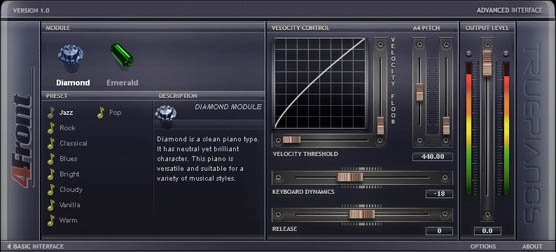
| 4FRONT TruePianos TruePianos is a new virtual piano VSTi based on a combination of physical modeling, synthesis and sampler techniques. Using a combination of the best what these individual technologies have to offer, TruePianos provides great playability by allowing itself to be easily adjusted to the combination of your unique playing style and the specific characteristics of your MIDI keyboard, instead of the other way around. It doesn't attempt to meticulously simulate existing pianos but instead provides realistic and expressive range of piano modules, each with individual dry sounding presets that you 'just play'. |
||
Fifer Free Better May 2026Proponents of free fire zones point to two primary benefits: speed and deterrence. In fluid combat environments, such as urban warfare or jungle counterinsurgencies, the ability to engage immediately can mean the difference between success and catastrophic failure. For example, during the Vietnam War, U.S. forces designated certain areas as free fire zones to target Viet Cong fighters who melted into civilian populations. Theoretically, this reduced the time between identification and engagement, making ambushes harder to execute. Additionally, some military strategists argue that the threat of unrestricted fire can deter insurgents from using civilian shields. However, the practical application of free fire policies has often led to disastrous humanitarian consequences. The core problem lies in the difficulty of distinguishing combatants from non-combatants in real time. In Vietnam, free fire zones became synonymous with indiscriminate artillery shelling and airstrikes on villages suspected of harboring enemy fighters. Civilian casualties mounted, and survivors frequently joined the insurgency out of grief or rage. This counterproductive cycle—where violence breeds more violence—has been observed in other conflicts, including recent operations in Iraq and Afghanistan. Consequently, free fire zones may achieve short-term tactical kills but fail strategically by generating new enemies faster than they eliminate old ones. fifer free In conclusion, while the appeal of unencumbered firepower is understandable in desperate combat situations, the historical and legal record suggests that free fire zones are an excessively blunt instrument. They erode moral authority, fuel cycles of violence, and frequently breach international law. Modern military doctrine has largely moved away from such designations in favor of precision engagement and stricter rules of engagement, recognizing that winning the trust of local populations is more valuable than fleeting tactical gains. A “free fire” mindset may win battles, but it rarely wins wars. If you meant something else by “fifer free,” please reply with a short definition or context (e.g., “It’s a term from a novel,” “It’s a local policy,” “It’s a typo for X”), and I will provide a completely new draft tailored to your intended topic. Proponents of free fire zones point to two Below is a short draft essay on Title: The Double-Edged Sword of ‘Free Fire’ Zones forces designated certain areas as free fire zones The term “free fire” refers to a military rules-of-engagement designation where forces are authorized to use any available weapon against any target perceived as hostile, without seeking prior clearance from higher command. While intended to enhance tactical responsiveness, the free fire concept raises profound ethical, legal, and strategic questions. This essay argues that although free fire zones can offer short-term operational advantages, they frequently undermine long-term counterinsurgency goals, violate principles of distinction and proportionality under international law, and risk alienating civilian populations. Legally, free fire zones exist in a gray area. International humanitarian law, particularly the Geneva Conventions, requires parties to a conflict to distinguish at all times between civilians and combatants. A blanket designation that permits firing on any moving person or structure arguably violates this principle of distinction. Moreover, commanders must ensure that attacks are proportional—that the anticipated military advantage outweighs incidental harm to civilians. Free fire zones, by their very nature, make such case-by-case proportionality assessments difficult, if not impossible, to perform in good faith. |
||
| 4FRONT BASS MODULE (VSTi) The bass module is a morph between sample playback and a synthesizer. Original string excitation is sampled, and then sound is modeled. Playing chords will add extra fat rumble, like when playing a real bass guitar. Bass guitar range was artifically extended up and down, so that higher notes and parts can be played as well. |
||
|
4FRONT RHODE MODULE (VSTi)
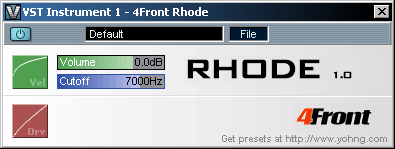
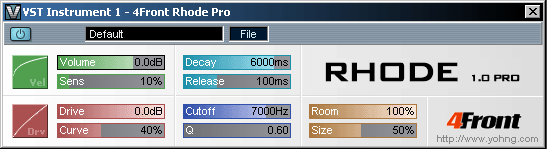
A vintage Rhodes/Wurly typed piano module with gentle overdrive. This module reproduces the classic sound similar to Rhodes/Wurlitzer pianos. Module is not sample based, and the sound is generated on-the-fly, therefore there are no sampling layer switches - vintage rhodes overdrive is smooth, clean and continuous. Difference between Basic (free) and Pro (commercial) modules To get a common idea of what exactly is different, check the screenshots below: Basic version:
As you can see, basic version is generally lacking envelope, sensitivity/drive and room controls, that Pro version has. If you like to get this kind of controlling over 4Front Rhode sound, you may want to get Pro version. MP3 Demos |
||
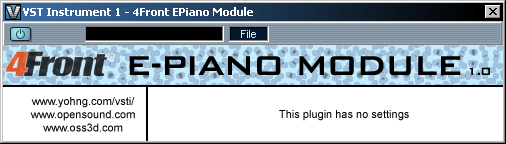
| 4FRONT E-PIANO MODULE (VSTi) E-Piano module with a rich, warm and silky sound. It is quite unique by its character. The module is made with a hybrid technology, which involves sample playback and synthesizing within one case. For its quality, module has reasonable small size. |
||
|
4Front XLimiter (VST/DX)
A gentle and soft brickwall limiter processor. Primary design goals: - Master track brickwall compression - Vocal track compression - Solo track compression A special multistage algorithm provides a very soft transition envelope, thus rapid level changes at extreme Threshold level will not pump or distort as much as with the other processors. The limiter employs best properties of a single band processor, whereas additional techniques are used to provide advantages of "continuous multiband" processing. Usage: With the default settings it will limit the signal at 0dB. This is useful to plug into the master effect bin of a multitrack software. You can lower Threshold value to bring up the volume of the track. If you are limiting a vocal track - you can also set appropriate ceiling value to control the output volume. If you have deessing or disturbing frequencies problem, try using this effect as a vocal or solo processor. In most cases you will not need an additional de-essing, as XLimiter will handle those transients properly. 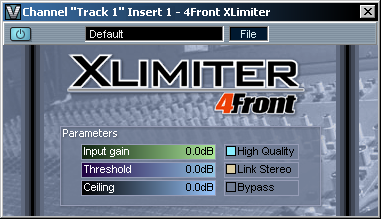 |
||
|
4FRONT AUXITER (VST/DX)
This is a high frequency refresher exciter-type plugin. It brings clarity to the high end by regenerating high frequency harmonics. Primary design goals: - Vocal enhancer - Per/track enhancer - Master track restoration/refreshment - Old tracks restoration Usage: First try to figure right Frequency slider value for your track, then control the Harmonic, Drive and Mix levels to get the best enhancement. 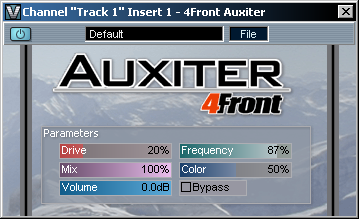 |
||
| 4FRONT SAND BRUSH (VST/DX) The plugin completely regenerates high frequencies, basing on the existing partials. The plugin can be used to apply on hihats and other percussive sounds with high frequency content, and also can be used on other tracks to add "sand". Depending on the settings, plugin can be also used to emulate the vintage vinyl sound. Primary design goals: - Sand for vocal and solo tracks - Bring life back to sampled strings - Track restoration (including MP3) - Vintage effect (to create vintage sound) The plugin contains multiple presets for various track types. 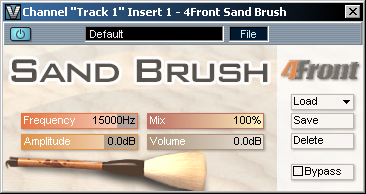 |
||
| 4FRONT CONTOUR MAX (VST/DX) The plugin is designed to change the basic frequency contour of a sound track, or the overall frequency balance of a master. Primary design goals: - Master processing - Per-track processing for balancing low and high end - Track restoration The plugin contains multiple presets for various track types. 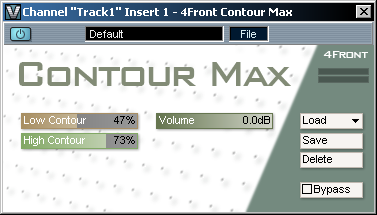 |